
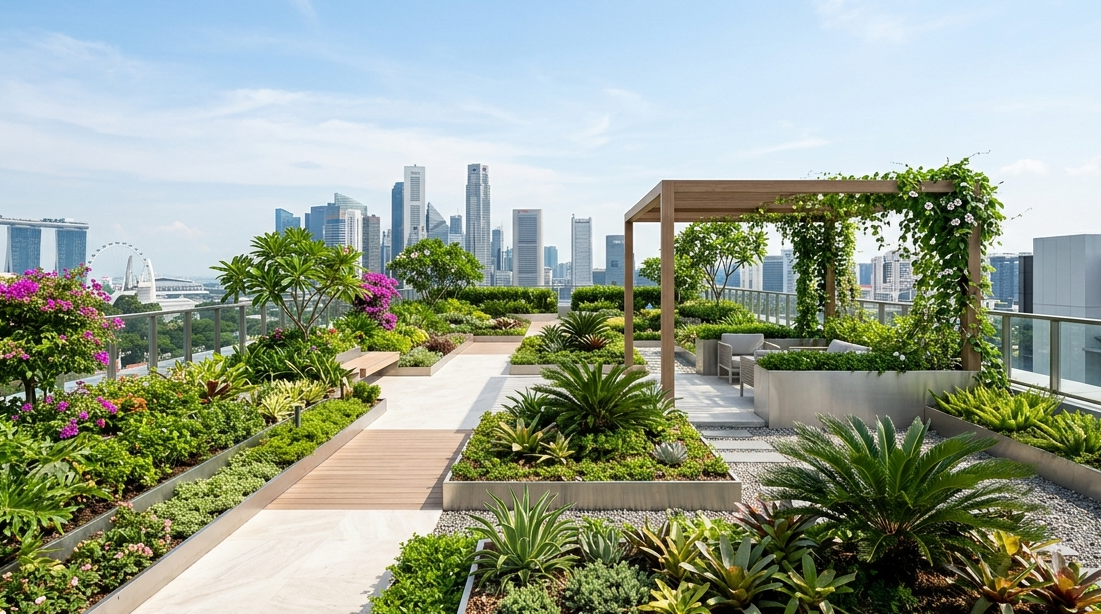
Singapore has some of the most spectacular rooftop gardens in Asia. From the iconic 1-Arden Sky Garden perched 280 metres above Raffles Place to the community gardens on HDB carpark rooftops in Choa Chu Kang — our city has transformed concrete roofs into living, breathing ecosystems that locals and visitors seek out every week.
But this guide serves two audiences. First, if you’re looking for the best rooftop gardens in Singapore to visit — we’ve mapped the city’s finest public green roofs in Section 1. Second, if you own or manage a building and want to install a professional roof top garden in Singapore — this is the most comprehensive build guide available online in 2026.
GreenGarden has designed, installed, and maintained commercial rooftop gardens across Singapore for over 30 years. We also manage the full NParks Skyrise Greenery Incentive Scheme (SGIS) application process — a government grant that reimburses up to 50% of your installation costs, capped at $200 per m². Most building owners we meet have never heard of it.
Best Rooftop Gardens in Singapore to Visit in 2026
Before the building science — here are the city’s finest accessible rooftop gardens, the benchmark any new installation should aspire to match.
What makes Singapore’s rooftop gardens world-class is the engineering beneath the greenery — root barriers, lightweight substrates, tropical plant selection, and automated irrigation calibrated for our climate. That same technical expertise is what GreenGarden brings to every commercial installation.
What is a Roof Top Garden?
A roof top garden — also called a rooftop garden, green roof, or skyrise garden — refers to professionally designed landscaping on a building’s roof. NParks’ Skyrise Greenery programme defines two main system types:
| Extensive green roof | Intensive roof garden | |
|---|---|---|
| Plants | Low groundcovers, sedums, succulents | Shrubs, lawns, trees, full landscapes |
| Substrate depth | 60–150 mm | 300–1,000+ mm |
| Structural load | 90–150 kg/m² | 300–1,500 kg/m² |
| Access | Not designed for foot traffic | Fully accessible — social & recreational |
| Maintenance | Minimal | Regular professional visits |
| SGIS grant eligible | ✓ Up to $200/m² | ✓ Up to $200/m² |
Why Install a Roof Top Garden in Singapore? Key Benefits
Reduces energy costs — measurably
Research on Singapore commercial buildings shows rooftop greenery can reduce annual energy consumption by 1–15% and space cooling load by up to 79% (NUS / ScienceDirect). Green roofs reduce surface temperatures by 20–30°C — directly cutting the heat load on air-conditioned floors below.
Doubles your waterproofing lifespan
Exposed membranes in Singapore’s UV intensity degrade in 5–10 years. A properly installed green roof system protects the membrane from thermal stress — NParks data confirms a green roof can extend membrane life to 20+ years, generating long-term savings that often exceed the installation cost.
Qualifies for BCA Green Mark certification
Rooftop greenery contributes directly to the Greenery Provision score in BCA’s Green Mark assessment. For buildings targeting Green Mark Certified through Platinum, it’s one of the most cost-effective single-measure strategies — especially combined with the NParks SGIS co-funding.
Increases property value and tenant appeal
Green-certified commercial buildings in Singapore command 5–15% rental premiums (CBRE, Knight Frank). A professionally maintained rooftop garden is a tangible ESG asset that supports the sustainability reporting requirements increasingly demanded by MNC tenants.
Manages stormwater during Singapore monsoons
Extensive green roofs retain 50–90% of light rainfall events — reducing peak discharge and stress on building drainage systems, and potentially reducing PUB drainage contribution charges.
💰
The business case in numbers
BCA, URA & NParks Regulations in Singapore
Three regulatory bodies are involved. GreenGarden coordinates all submissions on your behalf:
BCA — Structural assessment (mandatory for all)
The Building and Construction Authority requires a structural assessment by a registered QP or PE before any load is added to a roof. Non-negotiable regardless of installation size.
- Extensive green roofs (90–150 kg/m²): most existing commercial roofs can accommodate without reinforcement
- Intensive roof gardens (300–1,500 kg/m²): full structural review required; older buildings may need reinforcement
- Tip: If your building is undergoing A&A works, incorporate the green roof into the existing PE submission to reduce costs significantly
URA — Planning permission (case-by-case)
Permanent rooftop structures — pergolas, shelters, raised planters — may require URA planning approval if they alter the approved GFA or building height. Lightweight plant-only installations typically do not require URA approval.
NParks — Skyrise Greenery Guidelines
- Minimum 80% greenery coverage of the proposed plan area at completion
- Design must address wind and structural loading at the specific roof elevation
- Installed greenery must be maintained for a minimum of 5 years post-completion (SGIS undertaking period)
- Installation must not be in an enclosed or fully indoor area
💰
Critical: apply to NParks BEFORE works begin
The SGIS Grant: Get Up to 50% Off Your Roof Top Garden in Singapore
Most building owners we meet have never heard of this grant. NParks’ Skyrise Greenery Incentive Scheme (SGIS) provides up to 50% co-funding on rooftop garden installation costs. GreenGarden manages the entire application process on your behalf.
How much can you claim?
SGIS is a government reimbursement scheme — you complete installation first, then claim back up to 50% of eligible costs.
$200/m²
$500/m²
50%
50%
Real example: A 400m² commercial rooftop garden at $100/m² = $40,000 total. SGIS covers up to 50% = potential $20,000 reimbursement. Net cost: $20,000 — for a 20-year asset reducing your energy costs every month.
Who qualifies?
- Commercial buildings (offices, retail, hotels, serviced apartments)
- Industrial developments
- Institutional and community buildings (schools, hospitals, places of worship, CCs)
- Non-landed residential — common areas only (condominiums, MCSTs)
- Mixed-use developments
The building must be physically existing and occupied at the time of application, or undergoing A&A works. Applications are first-come, first-served subject to availability of funds — apply early.
What costs does SGIS cover?
- Green roof and vertical greenery system components
- Root barriers and waterproofing directly related to the greenery works
- Plant materials and engineered growing media
- Automated irrigation systems
- Drainage materials (geotextile membranes, water retention trays, drainage cells)
- PE fees and authority submission costs related to the greenery installation
Not covered: maintenance costs, lighting, artificial plants, or hardscape elements (benches, decking, signage).
Commercial Rooftop Garden Design Principles
Creating a commercial rooftop garden in Singapore is about mixing beauty with practicality. It’s important to blend tropical garden design with commercial landscape design — spaces that are inspiring and useful for everyday business needs.
Balancing Aesthetic Appeal with Functionality
A good commercial rooftop garden looks great and serves a purpose. Tropical garden design picks plants that do well in Singapore’s weather. Materials like weather-resistant decking add strength. Spaces for employees should look good but also be useful — shaded breakout areas, paths that double as walkways, easy-to-care-for plants. Choosing plants that change with the seasons keeps the garden interesting all year while meeting Singapore’s urban gardening needs.
Creating Accessible Spaces for Employees and Visitors
Start with safe, easy-to-use designs. Follow regulations like BCA accessibility codes to ensure paths are wide and safe. Use non-slip surfaces for rainy days. Good lighting and shaded areas make the garden usable at night. Adding seating with power outlets turns it into an outdoor workspace. Comfortable seating and shaded spots encourage staff to use the garden regularly. Clear signage and quiet areas help visitors — they make the garden a welcoming place for client meetings or quiet time.
Incorporate Brand Elements into Your Garden Design
Your brand can influence the garden’s design. Use your colours in hardscape materials or plant selection. Choosing sustainable materials shows your commitment to the environment. Tropical garden design can use local plants to connect with Singapore’s nature. Even small touches — branded signage, custom planters, sculptural art — can reflect your brand values. The goal is to create a space that reinforces your brand while remaining functional.
Apply for SGIS with GreenGarden
We manage the full SGIS application process — from eligibility check to reimbursement claim. Contact us before engaging any other contractor.
Free for qualified projects · 30-year track record · SGIS managed end-to-end
How to Build a Roof Top Garden in Singapore: Step-by-Step
GreenGarden’s installation process, refined across 30 years of commercial rooftop projects:
1
Initial site assessment (free)
We visit your property to evaluate roof condition, structural capacity, access constraints, and sun/wind exposure — at no cost for qualified projects.
2
Structural engineering review
Our registered QPs and PEs conduct the formal load assessment to determine which system type is viable and whether reinforcement is needed.
3
SGIS pre-application (if applicable)
We submit your site details to NParks for eligibility confirmation and pre-approval before you commit to any project costs. Works cannot begin until NParks grants pre-approval.
4
Concept design and plant plan
Our landscape architects produce a full design: species list, substrate specification, irrigation layout, drainage map, and access provisions — aligned with NParks Skyrise Greenery Guidelines.
5
Authority submissions
We coordinate BCA structural plan submissions and URA planning queries where required. All documents prepared and managed by our team.
6
Waterproofing and root barrier installation
The most critical phase. We use root-resistant membranes tested for Singapore’s tropical conditions. This layer determines whether your investment lasts 5 years or 25+ years.
7
Substrate and drainage layer
Lightweight engineered substrates — never regular garden soil — calibrated for your plant selection, weight limits, and Singapore’s bimodal rainfall.
8
Automated irrigation system
Drip irrigation with rain sensors calibrated for Singapore’s climate. Inter-monsoon dry spells (February and July) are the leading cause of plant loss on unirrigated rooftops.
9
Planting and 3-month establishment
Plants installed per the approved plan. Intensive monitoring during the first 3 months to ensure establishment, under warranty.
10
Handover and maintenance programme
We train your facilities team and establish a monthly schedule designed to meet NParks’ 5-year SGIS undertaking obligation.
How to Build a Roof Top Garden in Singapore: Step-by-Step

Singapore’s rooftop microclimate is uniquely demanding: UV Index 10–12, reflected heat, strong monsoon winds (40–60 km/h), and rapid substrate drying. GreenGarden’s 30-year field-tested recommendations:
| Plant | Type | Min. depth |
Difficulty | Why it works |
|---|---|---|---|---|
| Portulaca (Moss Rose) | Succulent groundcover | 80mm | Easy | Drought-tolerant, full sun, fast-spreading — ideal for extensive roofs |
| Sedum spp. | Succulent | 60mm | Easy | NParks-recommended; lightest load; SGIS-compliant |
| Bougainvillea | Flowering shrub | 300mm | Easy | Wind-tolerant, drought-resistant; stunning tropical colour |
| Pandanus utilis | Tropical shrub | 400mm | Easy | Salt-spray tolerant; excellent for coastal / elevated rooftops |
| Heliconia spp. | Tropical flower | 400mm | Moderate | Bold tropical look; attracts Olive-backed sunbirds |
| Ipomoea batatas (Sweet Potato) | Edible groundcover | 150mm | Easy | Fast-growing; popular for HDB community and school rooftop gardens |
| Murraya koenigii (Curry Leaf) | Edible herb | 350mm | Moderate | Productive and aromatic; regular pruning keeps height manageable |
| Plumbago auriculata | Flowering shrub | 250mm | Easy | Continuous blue flowers; exceptional heat tolerance |
| Thunbergia grandiflora | Climbing vine | 300mm | Moderate | Fast structure coverage; reduces reflected heat from parapet walls |
| Rhapis excelsa (Lady Palm) | Palm | 500mm | Moderate | Elegant; shade-tolerant; ideal for accessible gardens with shelter |
Maximising ROI on a Commercial Rooftop Garden
A commercial rooftop garden can deliver real returns when managed well. The financial case combines energy savings, asset protection, property value uplift, and revenue opportunities.
Energy Savings & Roof Membrane Protection
Green roofs keep buildings cool, cutting air-conditioning costs and lowering utility bills. Healthy plants also protect roof membranes from direct sun exposure, extending lifespan and saving on replacement costs. The combined utility-and-maintenance saving is the headline ROI driver for most commercial properties.
Property Value & ESG Positioning
Demand for eco-friendly commercial spaces is growing. Sustainable rooftop gardens can lift property value and attract tenants and buyers who prioritise environmental performance. Featuring your garden in marketing demonstrates commitment to green initiatives — a tangible signal for ESG-aligned clients. This is increasingly relevant for Singapore’s commercial real estate as BCA Green Mark certifications become decision factors.
Employee Wellbeing & Productivity
Studies link green workspaces to reduced sick days and better collaboration. Encouraging outdoor meetings or lunch breaks improves workplace culture without extra cost. The wellbeing benefit shows up in lower turnover, fewer sick days, and stronger employer-brand positioning — measurable in HR metrics.
Direct Revenue Opportunities
Some commercial rooftop gardens earn direct revenue: hosted events, workshops with venue fees or sponsorships, or growing herbs and vegetables for the building’s café. Tracking BCA Green Mark contribution alongside energy bills and employee feedback helps justify the investment with hard data.
Roof Top Garden Cost in Singapore: 2026 Real-World Estimates
| System | Gross cost | After SGIS (est.) | Best for |
|---|---|---|---|
| Extensive green roof | $80–$150/m² | $40–$75/m² | Industrial, warehouse, large flat commercial roofs |
| Semi-intensive | $150–$300/m² | $75–$150/m² | Mixed-use, smaller accessible areas |
| Intensive roof garden | $300–$800/m² | $150–$400/m² | Commercial, hospitality, premium residential |
| PE/QP assessment | $2,000–$8,000 | Covered by SGIS | Mandatory for all installations |
| Automated irrigation | $3,000–$15,000 | Covered by SGIS | Strongly recommended for all systems |
| Monthly maintenance | $300–$2,000/mo | Not covered | Meets NParks 5-year undertaking requirement |
Maintaining a Roof Top Garden in Singapore
Monthly maintenance checklist
- Slow-release fertilisation — nutrients leach rapidly from lightweight substrates during heavy monsoon rains; monthly top-up is non-negotiable
- Irrigation system inspection — verify sensor calibration, clean drip emitters, confirm timer schedules
- Pruning and shaping — keep plants within approved structural weight limits and height restrictions
- Integrated Pest Management (IPM) — spider mites, aphids, and mealybugs peak during inter-monsoon dry periods
- Drain outlet inspection — clear all drainage outlets before peak rainfall periods; a blocked drain during a Singapore thunderstorm causes catastrophic waterlogging
- Weed management — rooftop weeds are wind-dispersed and persistent; monthly removal prevents root competition
Monsoon-season priorities
- Before NE Monsoon (Oct–Nov): inspect and secure tall shrubs; clear all drain outlets
- After NE Monsoon (Jan–Feb): assess wind damage; inspect waterproofing; re-calibrate irrigation sensors
- Before SW Monsoon (May): inspect substrate for compaction; assess plant health after dry inter-monsoon
NParks SGIS requirement: rooftop greenery must be maintained to 80% lushness for 5 years post-installation. Failure to maintain can result in full grant clawback on a pro-rated basis. GreenGarden’s maintenance contracts are designed specifically to meet this obligation.
Year-Round Maintenance & Pest Management for Elevated Gardens
Keeping a rooftop garden in top shape in Singapore’s climate requires planning by season. The Northeast and Southwest monsoons each bring different challenges — and elevated gardens have pest pressures distinct from ground-level landscapes.
Monsoon-Calibrated Maintenance Schedule
Northeast Monsoon (December-March): clear drains to avoid waterlogging, secure planters against strong winds. Southwest Monsoon (June-September): adjust watering as humidity rises, watch for fungal disease. Dry inter-monsoon periods: increased irrigation cycles, more frequent visual inspections.
Check the garden every two weeks for pests during active seasons. Use a digital log or app to track plant health and water use. Train your team on rooftop-specific challenges — securing plants, soil moisture checks, fall protection during maintenance.
Common Rooftop Pests in Singapore
Aphids, mealybugs, and spider mites love warm humid conditions, so spotting them early matters. Check new plants for snails or slugs before placement. Birds and rodents can be a problem on accessible rooftops — use netting where appropriate. Quick action stops infestations before they spread across the garden.
Eco-friendly Pest Control with IPM
Integrated Pest Management (IPM) uses multiple methods together. Ladybirds fight aphids; neem oil offers gentle chemical control. Physical traps and netting stop pests without chemicals. Timing treatments with the rain cycle is smart — heavy rain washes off topical applications. Improving soil health with compost helps plants resist pests naturally.
Preventing Disease in Tropical Conditions
Fungal diseases like powdery mildew or root rot thrive in high humidity. Good drainage and airflow help. Choose plants that resist disease well. Regular cleaning — removing debris, deadheading flowers — stops diseases from spreading. Combining these steps with eco-friendly pest control keeps the garden healthy and beautiful all year.
Frequently Asked Questions — Roof Top Garden Singapore
Do I need BCA approval to install a rooftop garden in Singapore?
How much does a roof top garden cost in Singapore in 2026?
Is there a government grant for rooftop gardens in Singapore?
What is the SGIS grant and who can apply?
Can I install a rooftop garden on an HDB flat in Singapore?
What is the difference between an extensive green roof and an intensive roof garden?
How long does it take to install a rooftop garden in Singapore?
What plants are best for rooftop gardens in Singapore?
How much does rooftop garden maintenance cost in Singapore?
Will a rooftop garden damage my roof waterproofing?
Transform Your Rooftop — Free Site Assessment
GreenGarden has installed and maintained rooftop gardens across Singapore for over 30 years. We handle design, BCA submissions, SGIS grant applications, installation, and maintenance — all in one team.