
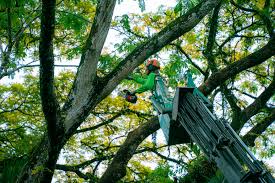
Why Proper Pruning Matters
Pruning is more than just cutting away branches for aesthetics — when done well, it supports the tree’s structural integrity, disease resistance, and long-term health.
- By removing dead, diseased, or crossing branches you reduce entry-points for pathogens and injury sites. For example, pruning out crossing or rubbing branches helps minimise self-wounding.
- Structural pruning (especially in younger trees) sets up a strong “architecture” (dominating leader, well-spaced scaffold branches) so that the tree can resist storms and wind.
- Proper timing and technique help the tree heal faster, regrow with vigour, and avoid long-term decline. As an example: pruning in the dormant season helps the tree use stored energy when it can best repair wounds. (University of Minnesota Extension)
- Conversely, poor or heavy pruning (e.g., cutting too much at once, leaving large open wounds, poor cut placement) can stress the tree, slow growth, reduce its lifespan and increase failure risk. (PubMed Central)
To underline the point: correct pruning is preventive care for trees — fewer problems, less risk, better long-term performance.
Some statistics
Here are four useful quantified insights to anchor the importance of pruning:
- In one urban-forest modelling study, pruning of urban trees every ~6 years plus a 1% yearly mortality rate resulted in retaining about 93.5% of the maximum ecosystem services possible for the species studied — meaning that appropriate pruning can go a long way toward preserving canopy benefits. (ResearchGate)
- In a study of urban green-area trees, average crown density (leaf/branch fill) was 67.96%, crown transparency (light passing through) 35.19%, and dieback only 1%. These metrics correlate to tree health condition. (MDPI)
- A well-cited rule of thumb: remove no more than one-third (≈33%) of a plant or tree’s live foliage in one pruning session to avoid excessive stress and undesirable regrowth. (Extension | University of New Hampshire)
These numbers show that regular, moderate pruning is far better than rare, heavy cuts.
When to Prune
Selecting the right time is crucial. Pruning at the wrong moment can undermine tree recovery or invite disease.
Dormant season is usually best
- For many deciduous trees, late winter or early spring (just before new growth starts) is ideal because the tree is dormant, fewer leaves obscure branch structure, and energy reserves are relatively high. (University of Minnesota Extension)
- Pruning then means fewer active pests, less sap-bleeding (for certain species) and less stress overall. (Utah State University Extension)
When to avoid heavy pruning
- Avoid major cuts in late spring/summer when the tree is in active growth because wounds will heal more slowly and may lead to excessive regrowth. (Extension | University of New Hampshire)
- Avoid pruning in extreme heat, drought or frost periods because the tree’s recovery is compromised. (Even if the literature is less numerical here, many arboriculture sources emphasise this.)
- Avoid removal of large canopy portions in one go — the “no more than one-third” guideline is relevant here. Also, doing large wounds late in the growing season may lead to dieback.
Consider species & local climate
- Some species have special needs. For example, trees that “bleed” sap (like certain maples, birches) may be better pruned when the sap flow is lower (often late spring or summer) rather than early spring. University of Minnesota Extension
- Local climate and seasonal stress (heat, drought, storm season) should influence your scheduling.
Certified, Safe, and Sustainable Landscaping Services
Looking to prune your trees?
We are an NParks-certified landscaping company under full NEA licensing, compliant with ISO 9001 and bizSAFE Star standards. Every pruning job follows WSH safety guidelines and uses eco-friendly, NEA-approved tools to protect both people and the environment.
Our WSQ-trained arborists ensure safe, sustainable, and professional results every time.
Call 8488 5000 to book your assessment with our certified team today.
How to Prune a Tree
Ensuring the right basics sets the foundation for a healthy tree.
1. Evaluate the tree’s current condition
Before making cuts, assess:
- Are there dead, diseased, broken branches? These are priority removal targets.
- Are there crossing or rubbing branches, weak branch unions, codominant stems (two similar branches from the same point) that may split later? Structural defects like these should be addressed.
- Is the canopy overly dense, blocking light penetration and air circulation? Opening up the canopy improves interior health.
- What is the tree’s growth stage? A young tree vs mature tree needs different pruning priorities.
When You Should Prune
You should always consider tree species, growth rate, and seasonal physiology before cutting.
- Dormant season: This is ideal for most deciduous species because carbohydrate reserves are high and pest activity is low. Wounds close rapidly once growth resumes.
- Active season (summer): You can use this period for light canopy thinning or height control. Summer pruning suppresses vigorous shoot growth because it removes some photosynthetic surface while the tree is actively metabolizing.
- Avoid extremes: You should not prune during severe drought, extreme heat, or leaf-out flushes when trees expend maximum energy on new growth.
If a branch breaks during a storm or shows active decay, you should remove it immediately regardless of season. Corrective pruning in emergencies prevents further tearing and reduces the wound size.
What You Should Prepare
Before starting, you should inspect the tree as a whole — from root flare to crown tips — and identify which cuts are necessary for your objective. Every cut should have a clear purpose.
Essential Tools
- Bypass hand pruners for twigs under 2 cm.
- Loppers for branches up to 4 cm.
- Curved pruning saw for limbs 5 cm or larger.
- Pole saw or pruner for elevated work within safe reach.
- Personal protective equipment: gloves, helmet, eye protection, and non-slip footwear.
- Disinfectant solution: use 70 % alcohol or a mild bleach mix to clean blades between trees, especially when working on diseased material.
You should always maintain sharp, tension-adjusted blades. Dull tools crush living tissue and create ragged wounds that delay compartmentalization.
Step 1: Assess and Select What to Prune
You should begin by defining the tree’s leader, scaffold branches, and subordinate shoots.
- Identify primary scaffold limbs — the main framework attached to the trunk. These determine long-term structure and should rarely be removed.
- Next, locate secondary or tertiary shoots that are competing, rubbing, or growing toward the interior of the crown.
- Remove dead, diseased, or damaged (3 D’s) wood first; this prevents fungal infection and improves inspection visibility.
When thinning, you should aim for uniform spacing of lateral branches around the trunk, roughly 30–50 cm apart vertically on young trees. Retain strong attachments with a U-shaped branch union and eliminate weak V-shaped forks that trap bark.
Never remove more than about 20–25 percent of the live crown in a single season. Excessive canopy loss disrupts the leaf-to-root ratio and can trigger water sprout growth or stress dieback.
Step 2: Make the Right Kind of Cut
Correct cut placement determines how efficiently a tree seals the wound.
You should always locate the branch collar — a slight ridge or swelling at the junction of the branch and trunk — and the branch bark ridge just above it.
Cut just outside the collar without damaging it. This area contains specialized cells that form woundwood to seal the site.
- Do not flush-cut: slicing into the collar removes the tree’s natural barrier zone.
- Do not leave stubs: a stub dries out and decays backward into the trunk.
For limbs thicker than about 5 cm, you should use the three-cut method:
- Make an undercut about one-third through the branch, 15 cm from the trunk.
- Make a top cut a few centimeters further out until the branch drops.
- Make the final cut just outside the branch collar, following its natural angle.
This technique prevents bark tearing and preserves the protective tissues the tree needs to compartmentalize the wound.
Step 3: Structural Pruning for Young Trees
When a tree is in its juvenile phase (typically under 20 years old), you should focus on structural pruning, not aesthetic shaping. The goal is to engineer a branch architecture that supports load distribution, vascular efficiency, and long-term mechanical stability. Poor early pruning results in co-dominant stems, included bark, and asymmetric load paths — all of which compromise tree biomechanics as the crown enlarges.
Establishing a Dominant Leader
You should identify one apical leader and maintain apical control throughout the formative period. If multiple upright leaders have developed, you should reduce or remove subordinate stems using reduction cuts back to a lateral branch with at least one-third the diameter of the parent stem. This ensures that the primary leader maintains hormonal dominance through auxin flow, suppressing vigorous but weakly attached competitors.
In species adapted to excurrent growth (e.g., most conifers), the central leader must remain uninterrupted. In decurrent species (e.g., many broadleaves), you should still define a primary axis to preserve vertical symmetry and reduce wind-induced torsion on the trunk.
Scaffold Branch Selection and Spacing
You should select scaffold branches with strong attachment angles (ideally 45–60°) and well-developed branch collars. Scaffold limbs should exhibit a branch aspect ratio (branch diameter ÷ trunk diameter at point of attachment) not exceeding 0.5; ratios above that threshold indicate excessive limb dominance and poor future stability.
Vertically, scaffold branches should be spaced at least 30–60 cm apart to distribute load along the trunk and maintain proper crown taper. Radially, you should stagger branches around the trunk to prevent weight concentration on one quadrant. The lowest permanent branch should begin at roughly one-third of the tree’s total height to maintain trunk clearance and taper.
Temporary and Subordinate Branch Management
During structural training, you should retain temporary branches on the lower stem to enhance trunk diameter growth through auxin translocation and cambial stimulation. These should be pruned gradually over several cycles, reducing their length by 50% annually to minimize wound size at eventual removal. Premature removal of all lower shoots can cause taper loss, leading to slender, unstable stems.
You should also suppress competing scaffold candidates by subordination rather than removal whenever possible. A subordinate cut shortens, but does not eliminate, a limb, reducing its vigor while allowing gradual occlusion of the branch base. This approach maintains continuous photosynthetic contribution and minimizes large wounds.
Avoid Over-Pruning
Excessive removal of live tissue depletes the tree’s stored carbohydrates, weakens root growth, and can induce epicormic sprouting from latent buds along the trunk. These sprouts (often called “water shoots”) have inferior vascular connections and low wood strength. You should therefore limit total live crown removal to no more than 20–25% in a single intervention, especially on mature specimens.
Step 4: Finishing Cuts and Wound Quality Assessment
Once pruning objectives are met, you should conduct a systematic review of each cut for physiological soundness and wound geometry.
- Cut placement: The final cut should originate just outside the branch bark ridge and extend downward and outward, preserving the branch collar. This ensures the tree’s compartmentalization system (CODIT — Compartmentalization of Decay in Trees) can activate effectively.
- Cut surface: You should ensure a smooth, planar cut with no torn cambium or bark flaps. Any tissue tearing exposes xylem and allows fungal colonization.
- Stub avoidance: You should not leave a stub; desiccated stubs become necrotic and create vertical infection columns.
- Tool sharpness: Use sharp, fine-tooth saws for final collar cuts. Coarse or dull blades crush the xylem and disrupt moisture gradients at the wound margin.
You should not apply wound dressings or pruning sealants unless conducting pathogen containment for specific genera (e.g., Quercus during oak wilt season). Decades of arboricultural research confirm that wound paints hinder callus formation and trap moisture, delaying closure.
Step 5: Post-Pruning Physiology and Maintenance
After pruning, you should expect the tree to enter a period of physiological recalibration. The canopy’s photosynthetic surface area has been reduced, so the tree redistributes resources to reestablish leaf-to-root balance.
Water and Nutrient Management
You should ensure consistent soil moisture to facilitate turgor pressure and callus cell expansion around wounds. Water stress during this phase restricts cambial activity and delays sealing. Conversely, overwatering can induce anaerobic root stress and reduce oxygen diffusion to fine roots.
Supplemental fertilization is only appropriate if a documented nutrient deficiency exists. Otherwise, high-nitrogen feeding after heavy pruning can trigger soft, rapid shoot regrowth prone to breakage.
Mulch and Soil Interface
Apply a 5–8 cm layer of coarse organic mulch across the root zone, maintaining a 10 cm mulch-free buffer around the trunk flare to prevent basal rot. This helps maintain stable root temperatures, improve microbial soil structure, and moderate evaporation rates.
Monitoring and Diagnostics
Over the following 6–12 months, you should inspect wound sites for:
- Callus roll formation — healthy callus will form a uniform ridge around the cut perimeter.
- Discoloration or exudate — signs of bacterial wetwood or fungal intrusion.
- Epicormic growth — excessive sprouting indicates the tree is compensating for over-pruning stress.
If any of these symptoms appear, you should adjust future pruning intensity or timing.
Step 6: Frequent Technical Errors
You should be aware of the errors most responsible for long-term decline:
- Topping: The indiscriminate heading of branches to arbitrary lengths. This destroys apical dominance and generates weakly attached shoots.
- Flush cutting: Cutting into the branch collar removes the natural boundary zone and accelerates decay progression into the main stem.
- Improper aspect ratios: Retaining scaffold branches exceeding 50% of trunk diameter promotes codominance and weak unions.
- Unbalanced crown reduction: Removing large limbs on one side destabilizes load distribution and root anchorage.
- Failure to clean tools: Using contaminated saws spreads canker and vascular wilt pathogens between trees.
Step 7: Long-Term Management Strategy
You should regard pruning as part of a planned arboricultural maintenance regime, not a one-time intervention. Mature trees require periodic reinspection every three to five years to evaluate crown structure, branch attachments, and wound closure. For juvenile trees, annual structural pruning ensures symmetrical development and minimizes future corrective work.
Document each operation — the percentage of live crown removed, the purpose of each cut, and the branch positions affected. These records form a management baseline for subsequent maintenance cycles.
When pruning aligns with biological timing, wound physiology, and mechanical load principles, the result is a tree that demonstrates optimal structural taper, balanced biomechanics, and strong compartmentalization defenses — the hallmarks of professional arboriculture.
Setting Up an Ongoing Pruning Plan
To achieve healthier growth, pruning shouldn’t be a one-off event but part of a plan.
Frequency
- Young trees: every 2-3 years for structural shaping.
- Mature, healthy trees: every 3-5 years (or as needed based on growth rate, species, condition).
- Always check annually for urgent issues (dead/diseased/hazardous limbs) even if full structural pruning is not needed.
Record-keeping
Keep notes of when and how much you pruned. This helps to avoid removing too much canopy in successive years and to monitor how the tree recovers.
Professional Tree Pruning by Certified Experts
Need safe and reliable tree pruning in Singapore?
As an NParks-certified and NEA-licensed landscaper, we operate under ISO 9001 and bizSAFE Star safety systems to deliver clean, compliant, and environmentally responsible work. Our WSQ-trained arborists follow proper pruning standards to keep your trees healthy, stable, and well-shaped all year round.
Call 8488 5000 to book your assessment with our certified team today.
References
- University of Minnesota Extension – Pruning Trees and Shrubs (2024).
- Illinois Extension – Cutting Back Branches Leaves Trees a Healthier Outlook (2023).
- UF/IFAS School of Forest, Fisheries, & Geomatics Sciences – Structural Pruning of Young Trees (2022).
- Urban Timber Tree – Tree Health Through Pruning (2025).
- UNH Cooperative Extension – Basics of Pruning Trees and Shrubs (2023).
- ResearchGate – Impact of Pruning and Mortality on Urban Tree Canopy Volume (2022).
- MDPI Forests Journal – Tree Crown Characteristics and Health in Urban Areas (2023).
- NParks Singapore – Guidelines for Tree Management and Pruning (2024).
- Ministry of Manpower – Workplace Health and Safety Guidelines for Arboriculture (2023).